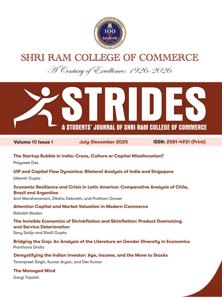
STRIDES – A STUDENTS’ JOURNAL OF SHRI RAM COLLEGE OF COMMERCE
ISSN 2581-4931
Volume 10, Issue 1 JULY– DECEMBER 2025
RESEARCH PAPERS
The Startup Bubble in India: Craze, Culture or Capital Misallocation?
Author : Preyosee Das
Abstract
Research PaperIndia’s startup boom produced over 100 unicorns and attracted unprecedented venture capital between 2016 and 2022. Yet the subsequent funding contraction exposed a wave of governance failures, valuation collapses, and insolvencies that market volatility alone cannot explain. This study argues that such instability is better understood as institutional misalignment: a condition in which investor behavioral dynamics, culturally legitimized growth norms, and governance structures within firms fail to reinforce financial discipline. Drawing on corporate governance theory, behavioral finance, and cultural institutionalism, the paper proposes an integrated Governance-Behavior-Culture (GBC) framework and applies it through a comparative case analysis of BluSmart Mobility and Lenskart, two similarly funded startups with sharply divergent outcomes. The analysis reveals that governance quality, not sector conditions or founder capability, is the primary determinant of startup sustainability.
Where governance is independent and operationally disciplined, firms weather contractions. Where it is symbolic, behavioral exuberance and cultural legitimacy amplify capital misallocation until collapse becomes inevitable. The paper reframes startup failure as a systemic institutional outcome and offers actionable implications for founders, investors, and policymakers.
UIP and Capital Flow Dynamics: Bilateral Analysis of India and Singapore
Author : Utkarsh Gupta
Abstract
Research PaperThis study examines the relationship between interest rate differentials, exchange rate movements, and capital flows between India and Singapore using monthly data from 2020-2025. The analysis tests the holding of Uncovered Interest Parity (UIP) condition and evaluates the effect of Exchange Rate Volatility on Foreign Direct Investment (FDI) inflows. This bilateral analysis provides an insight on global trade and economic activity in the post-pandemic era. OLS regression is employed after constructing the interest rate differential and a rolling measure of exchange rate volatility. Hypothesis testing shows a positive and statistically significant association between the interest rate differential and the INR/SGD rate, supporting the UIP hypothesis. In contrast, exchange rate volatility has no significant effect on FDI inflows, indicating that long-term investment decisions are largely insensitive to short-run currency fluctuations. These findings suggest that interest rate differentials influence exchange rate dynamics, whereas FDI is primarily driven by structural economic factors.
Keywords: Uncovered Interest Parity, Exchange rate volatility, FDI, Interest rate differential, India–Singapore.
Economic Resilience and Crisis in Latin America: Comparative Analysis of Chile, Brazil and Argentina
Author : Anvi Mansharamani, Diksha Debnath and Pratham Grover
Abstract
Research PaperThe Latin American debt crisis was one of the major economic crises that took place in the 1980s. Latin American countries had taken excessive loans during the 1970s and 1980s. This made them heavily reliant on short-term external debt. In the long run, the massive debt led to defaults by Latin American Countries. Through this paper, we examined the impact of the crisis on 3 major economies - Chile, Brazil and Argentina. The objective was to draw an analysis of their responses to the crisis and conduct a comparative study of the 3 countries. We also looked into Chile’s GDP growth rate, since it is proclaimed to have the best response to the crisis among the 3 countries, and applied regression to analyse which factors helped the Chilean government overcome the crisis. According to our results, Chile has performed comparatively best in all parameters by introducing the banking sector and debt restructuring, debt renegotiation, and exportled growth. The paper also highlighted how a reduction in unemployment and a focus on the current account surplus help in managing an economic crisis.
Attention Capital and Market Valuation in Modern Commerce
Author : Rishabh Madan
Abstract
Research PaperIn today’s digital economy, consumer attention is now considered an economically valuable resource, as opposed to an observed behavior. The paper aims to study the importance of “Attention Capital” which stands for the total economic value that consumer attention adds to a brand. Companies are increasingly focusing on consumer attention as traditional methods that revolves around assets and revenues are insufficient. The study proposes a conceptual framework along with a set of propositions establishing relationship between attention variables like retention rates, innovation capability and market capitalization. The research also studies the importance of attention capital and its impact on market capitalization in the new digital environment that emerged after Covid-19 pandemic through a case study of major global companies like Meta, Alphabet, Reliance and Netflix from 2020 to 2024. The proposed “Attention Capital Index” enables comparison between different companies and their relative attention intensity through secondary data. The results provide evidence that attention capital is an important variable for explaining market capitalization performance in contemporary times.
The Invisible Economics of Shrinkflation and Skimflation: Product Downsizing and Service Deterioration
Author : Savy Satija and Shaili Gupta
Abstract
Research PaperHave you ever noticed your favorite bag of chips getting smaller or airlines reducing legroom, yet the price remains the same? This phenomenon, known as shrinkflation and skimpflation, allows businesses to offset rising costs without visibly increasing prices. While these changes often go unnoticed in short term, they impact consumer behavior. This paper explores effects of these tactics on consumer perception. Using research and online survey, we examined historical trends in product sizing and consumer reactions. The findings reveal a sharp rise in shrinkflation within the snacks and household products, whereas skimpflation is more prevalent in hospitality and transportation. Many consumers don’t immediately notice these changes, but when they do, frustration grows. Businesses use such strategies to stay profitable, but fairness concerns remain. These hidden cost-cutting measures make consumers pay more for less value. This study emphasizes that true market fairness requires transparency, enabling consumers to make informed choices and hold businesses accountable. Overall, the study concludes that long-term consumer trust and sustainable market relationships depend on greater transparency, ethical pricing practices, and balanced regulatory oversight.
Bridging the Gap: An Analysis of the Literature on Gender Diversity in Economics
Author : Gender inequality, Representation, Bias, Diversity, Equity
Abstract
Research PaperThis paper examines the persistent gender gap in economics, highlighting the underrepresentation of women and the biases they face in hiring, pay, and publication. It reviews literature from 1995 to 2022, revealing that gender diversity enhances research quality and decision-making. Statistical evidence from two reports has been used to assess the severity of the issue and evaluate the impact of measures implemented over the years across various countries. Despite gradual improvements, systemic barriers continue to hinder women's advancement in the field,
necessitating targeted interventions to promote equity. Drawing on insights from reports and experimental studies, I have proposed measures such as enhancing early exposure to economics for women, ensuring unbiased recruitment processes, encouraging gender diversity in teams, and adopting double-blind peer reviews to promote fair assessment of academic work.
Demystifying the Indian Investor: Age, Income, and the Move to Stocks
Author : Taranpreet Singh, Kumar Aryan, Dev Kumar and Ashwani Kumar
Abstract
Research PaperThe purpose of this research was to understand investment behaviour in lieu of recent developments in the Indian economy and financial sector and more importantly, to understand the same through the demographic lenses of age and income. For this purpose, we conducted a survey of college students and working professionals and amassed a total of 500 responses. From our study, we were able to come to a variety of conclusions. We safely concluded that the Indian investors are becoming more rational in their approach and are strongly confident about the direction of equity markets and this is visible in how stocks beat out every other asset class in terms of preference by a huge margin. Platforms like Groww are taking over as the preferred means of investment and a significant proportion choose to invest into MFs via SIPs as opposed to lump sum. Additionally, we ran correlation tests for every question posed to respondents with age and income and have included the important findings here.
The Managed Mind
Author : Gargi Tripathi and Dr. Lipi Saxena
Abstract
Research PaperDoes the authority of the modern state end at the threshold of the human mind? While classical political theory defines liberty as the absence of external interference, contemporary governance has undergone a quiet transition toward the management of subjective autonomy. This paper addresses a definitive research question: How can meaningful agency be sustained when the mechanisms of power ranging from algorithmic architectures to institutional norms operate within the very fabric of the citizen’s consciousness?
The study identifies a significant vacuum in current legal and political frameworks, where the private sanctum of the consciousness remains vulnerable to non-coercive yet pervasive forms of influence. This epistemic colonization suggests that traditional rights of non-interference are no longer sufficient to guarantee true freedom of choice in a digitally mediated world. The paper concludes by proposing a necessary evolution of the social contract: the recognition of Cognitive Sovereignty. By establishing a proactive ethical and legal imperative to protect the integrity of the psyche, we can ensure that individual agency remains an inviolable jurisdiction in an increasingly interconnected age.
Best Three Paper (Volume 10, Issue 1 JULY– DECEMBER 2025 ISSN 2581-4931)
Awarded 1st Prize

Awarded 2nd Prize

Awarded 3rd prize